
Charlie Kirk’s Reputation Laundering
I hear Magda Goebbels made a great strudel.

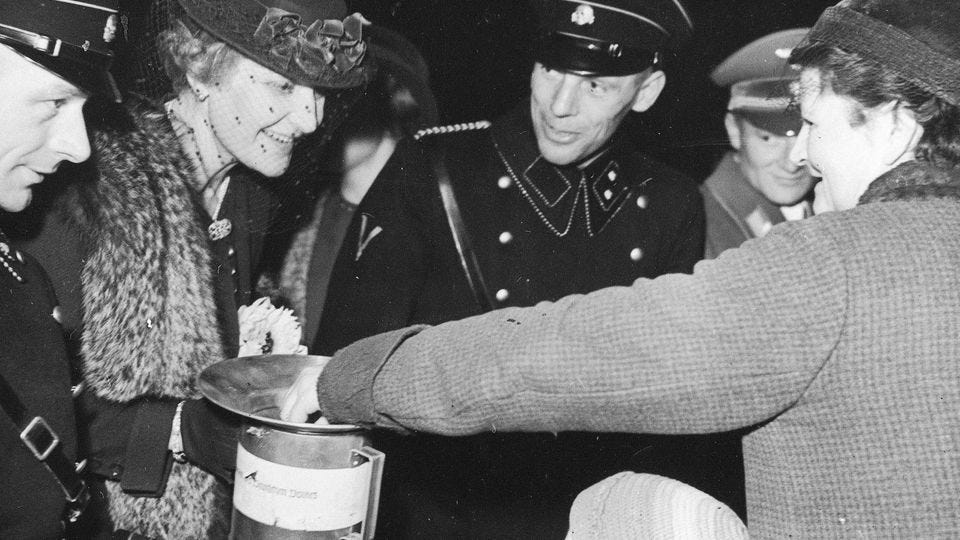
“My grandfather used to say ‘and Magda Goebbels made a great strudel’ and I never knew what it meant until after he died my grandmother explained some magazine did a fluff interview with Magda Goebbels a few years before WW2 that included her strudel recipe and my grandfather, who hated the Nazis with the passion of 10,000 suns, thought it was an example of the media sanitizing evil people and he would use the phrase when someone asked him to overlook a bad person doing bad things and focus on the good.”—Nick Rafter
This is not a story about Charlie Kirk’s widely reported dehumanization of trans people and people with migration backgrounds, or his platforming of what are regarded as ethno-nationalist conspiracy theories like “demographic replacement,” or other facts on record that now find themselves contested in public memory. This is a warning from history about the authoritarian capture of an already compromised media ecosystem.
Many mistakenly think that fascism arrives centrally as the state. In truth, fascism is the hijacking of the state’s functions and resources by power, including corporate interests, in which the field of journalism degrades from a flawed access economy to a tool of narrative control.
For this, we return to a paradigmatic moment in history, though certainly not the only one, when a single event was leveraged for mass violence. When a regime used a “shock”—say, a political killing, to take advantage of the existing power asymmetries of journalism to launder humanizing narratives for the purpose of authoritarian expansion.
The P in PR is for Propaganda
On November 7, 1938, a 17-year-old Polish-Jewish refugee named Herschel Grynszpan walked into the German embassy in Paris and shot Ernst Eduard vom Rath.
Herschel, born in 1921, was stateless by many definitions in that era. He was living as a refugee in Paris by 1936 after his family had been expelled from Germany. Vom Rath, on the other hand, was a cog in the Nazi dictatorship’s diplomatic service. A third secretary, a minor functionary whose aristocratic lineage and 1932 early adoption of National Socialist party membership had granted him nepo baby status and a plush assignment in Paris.
There were also rumors that vom Rath had associations with Paris’s gay circles, perhaps even sexual contact with a promise to help Grynszpan—which was then apparently reneged. These rumors of a duplicitous gay sugar daddy exploiting a Jewish minor were dangerous for the regime, and so were predictably suppressed while their preferred narrative was elevated.
Within hours of vom Rath’s death, Joseph Goebbels, Adolf Hitler’s Minister of Propaganda (a publicist with a government pension), immediately spun the killing as proof of so-called “Jewish aggression,“ seizing it as the pretext to inflame public sentiment and incite what would become Kristallnacht, the coordinated anti-Jewish pogroms. On November 9 and 10, 1938 synagogues were burned, Jewish businesses, homes, and schools were attacked across Germany and Austria, and many Jewish people were arrested or killed.
To underwrite this state-sponsored violence with public narrative, vom Rath’s martyrdom was manufactured almost immediately, as the state elevated him from essentially a PA to a national symbol. Vom Rath was given a state funeral in Düsseldorf, with Hitler and Ribbentrop present. He was decorated posthumously, promoted in rank in the couple of days after the shooting, but before his death. But Goebbels and the Nazi state couldn’t have done it alone. What many prefer not to remember is that most of the German press didn’t resist the lionization of Ernst vom Rath and the atrocities it authorized.
Access journalism then and now
History records that after vom Rath’s death, German news outlets emphasized his youthful promise, portraying him as a martyred servant of the Reich. They presented his death as an attack on Germany — on the whole of Christian Europe.
By 1938, newsrooms had been consolidated under the Reich Press Chamber and every journalist required state registration. Formal restrictions on media journalism had been in place since 1935. Film criticism, as such, was criminalized, so reviewers could only describe plots. What looked like a media ecosystem was already a mouthpiece. Journalists told their audiences the version of the story that felt safe to print. It is a mistake, however, to believe that journalism ever operated at a total remove from power. Even before the 1933 Reichstag Fire Decrees that gave the state formal tools to censor publications, ban opposition newspapers and arrest editors, German journalism was already shaped by networks of dependency.
During the Weimar period, journalists relied on the favor of politicians and financial backers. Most newsrooms were already operating under market pressure. Editors, many of them veterans of older imperial structures, often served as gatekeepers of ideological cohesion. Publishers operated under economic pressures shaped by ad revenue and the shadowy networks of elite society. And journalists depended on those same publishers for jobs. Everyone, from senior editors to cub reporters, understood that certain kinds of stories could draw unwanted attention, or just make life harder. And if the government controlled who got access to press conferences, then maintaining that access became currency even at the price of complicity, using one’s journalistic credentials to launder harm for public indoctrination.
Even in the US before the regime, you can see how proximity to power distorts ethical and transparent professional practice, how precarity compels journalists, particularly younger journalists, to cultivate access more than skepticism. The soft touch and honorarium from a publicist can carry more weight than a whistleblower with documentation.
This is not because the journalist involved decides they’re going to enable suppression, but because the system is already built to reward complicity. In today’s attention economy, access gets traffic. And within a precarious media ecosystem, where many writers are freelancers without benefits or institutional protection, the path of least resistance becomes the norm, even if what announces itself as journalism is essentially promotional copy.
Even if it means harmful narratives are laundered and astroturfed by corporate PR machines to manufacture consensus — and consent.
Recognizing reputation laundering — because you’re going to see more of it
To understand the stakes of remembering Charlie Kirk accurately, based on facts on record and not vibes, you have to widen the aperture to the meta story: the authoritarian capture of the media ecosystem in the United States. And if you want to recognize when a story is being laundered and the reputation of a powerful figure is being reframed for narrative control, there are concrete strategies. They come from academics studying misinformation/disinformation, propaganda and digital narrative warfare, as well as press freedom organizations. But any reader can apply them.
1. Follow the Money… and the Memory (same thing)
Ask: Who stands to benefit from this framing?
Reputation laundering often anticipates monetization, especially posthumous legacy monetization when the subject is dead or older.
Who profits from the legacy of Charlie Kirk? Turning Point USA most likely, as speaking fees, books, foundations, fellowships named in his honor. Even branded merchandise.
If reputational damage would interfere with those revenue streams, then you can expect the story to be strategically managed, but with plausible deniability.
2. Soft-Focus Humanization as Obfuscation
Ask: What concrete accountability, things that cost something like money and risk, are being taken in the present? What is tone and proximity versus alignment?
This is one of the most pernicious tools in the laundering playbook. You will recognize it because it starts with pathos and ends with silencing.
It sounds like: “He was a complicated figure…” “She had proximity to outsiders…”
These stories focus on vulnerability, tone, and anecdote, but the goal is to reframe the essence of the subject as emotional complexity, which functionally means above accountability.
If someone is facing public scrutiny, whether alive or dead, no amount of memoir-style storytelling should be permitted to obscure that. Watch for how the affective appeal is deployed to shield someone from scrutiny.
3. Trace Syndication and Identical Copy Across Outlets
Ask: Where did this story originate? Why is it repeating everywhere? Which stories is it competing with?
This was already a structural problem. Struggling newsrooms sign syndication deals or share content via wires, but it can be intensified by corporate priorities. PR firms push “embargoed” content to a slate of friendly reporters with their preferred narrative already baked in.
Pay attention when multiple outlets are running the same article with only minor differences, especially if those outlets are part of informal ideological networks or formalized media partnerships.
This is how laundering happens through repetition. One press release can become the story of record through sheer volume.
4. Interrogate Power Asymmetry in the Journalist–Subject Dynamic
Ask: Who needs who in this dynamic? Who can walk out of the room?
The most dangerous journalism isn’t always hostile. Sometimes it’s friendliness concealing asymmetry.
If there was an interview, what are the relative positions of power and privilege between interviewer and subject? Did the journalist depend on proximity to the subject for access? What was the setting? Who had editorial control, and to what extent?
Even well-meaning journalists can end up complicit in laundering a narrative they did not fully control.
5. Watch for Strategic Keyword Framing (SEO Manipulation)
Ask: Which keywords are directing traffic? Who could contest their discursive use?
Search engine manipulation (SEO) is now one of the most effective tools for obscuring dissent. To launder the reputation of a controversial public figure, content teams will flood search engines with high-ranking keywords—attached to affects, communities, media properties—all optimized to capture the top results for their name.
The goal is to bury dissent. The faster a PR team can flood Google, Bing, and even federated networks with the same soft-focus coverage, the faster they push down critical analysis. And because platforms increasingly rely on engagement-based ranking, and not chronological order or factual weight, those critical posts may never surface for most readers.
If you want to find the truth, you often have to search like a skeptic.
6. Pay Attention to Suppression at the Platform Level
Ask: What will I find after Page 1?
Online platforms should be regulated like public utilities, but they’re owned by private companies with opaque proprietary algorithms who do not need to justify why some stories are buried and some are elevated. (Unless you’re in the EU, which is perhaps the last legal firewall against corporate censorship online, but you still need to file a DSA statement of reasons to request transparency.)
Platform suppression often mimics or colludes with corporate and state control and is a sophisticated operation. It can involve shadow de-indexing, where a news story technically exists but cannot be found. It can include Terms of Service violations manufactured through coordinated flagging of dissenting, or maybe just inconvenient, voices. It can look like neutral phenomena, invisible to most, but they correspond to real-world media pressure campaigns.
This kind of suppression is expensive and relies on manipulation of different search engine algorithms. Sometimes competing stories aren’t fully de-indexed from search, but only pushed down past Page 1 because 75% of people don’t read further. So make a habit of checking different search engines (DuckDuckGo, StartPage, Brave, Ecosia) and reading past Page 1.
You may be surprised at what you find.
Addendum: How do you know what you know?
This is a non-exhaustive guide to how you can begin to recognize narrative laundering.
More harm will be laundered, and you probably have already read countless stories disseminated as journalism that were quietly laundering harm. Maybe you can think back and ask yourself some questions.
Consider starting with: Who is this story serving? Why now? And begin to imagine who would dissent, because one day, if it hasn’t happened already, that might be you.